
vibrant urban quarter for everyone

The greater Dresden area
is winning and growing
SHAPING URBAN DEVELOPMENT
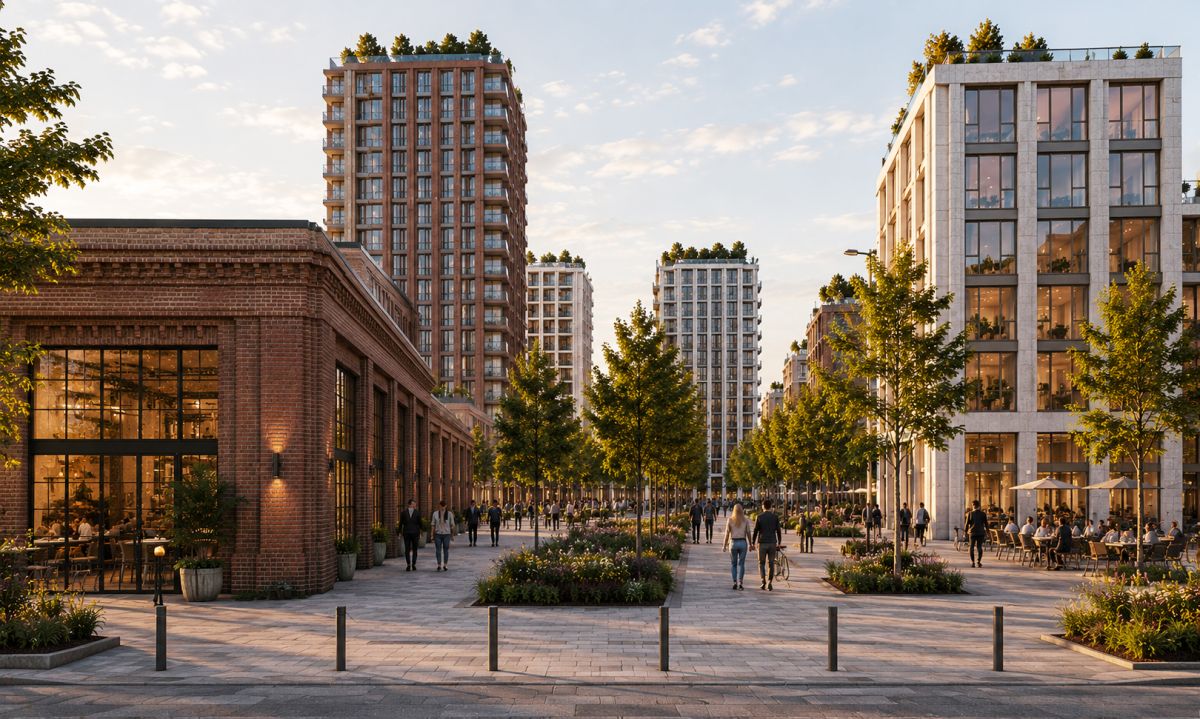
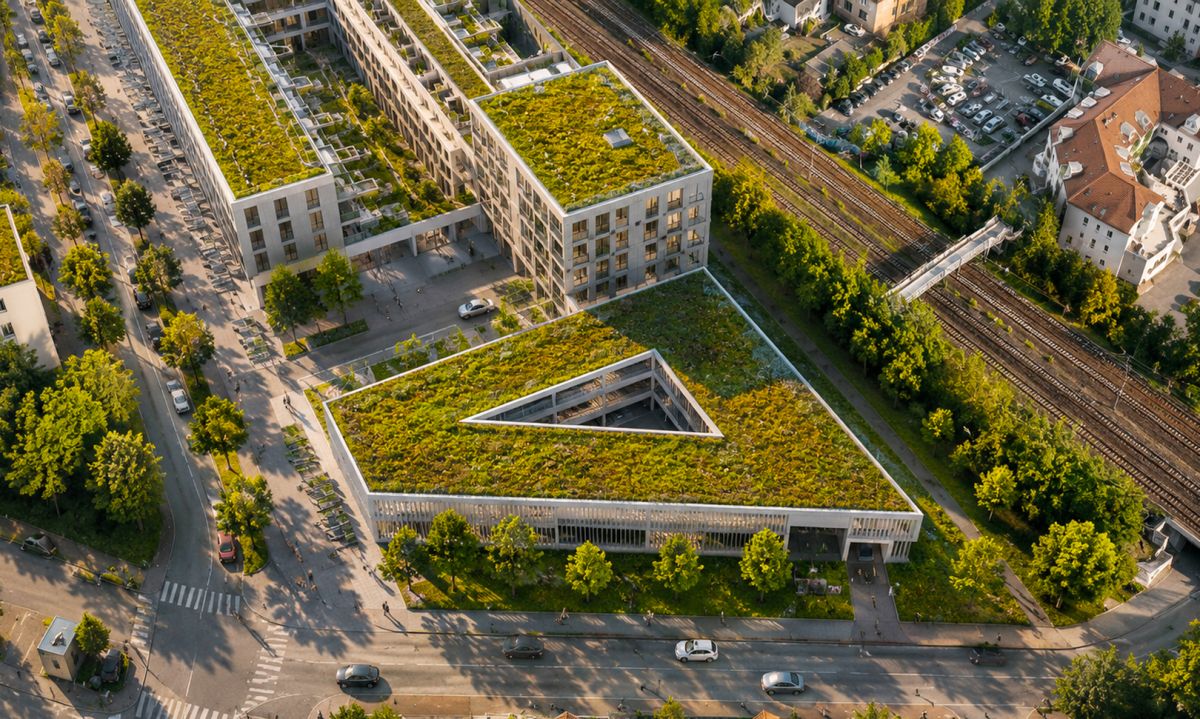
The overall scale of roughly 7.0 hectares and the uniqueness of the site make it possible to create an autonomous, powerful district that sets spatial and design accents and fosters a pleasant, welcoming atmosphere.
The strong presence of existing structures will be preserved and continue to live on as a layer of history alongside the new. New built forms — deliberately including taller buildings in places — will, in harmony with the existing fabric, promote diversity, openness and social mix.
On the entire site, which can be divided into 10 separately developable quarters, high-quality spaces will be created for residential use (approx. 70%), offices and commercial use, retail and community facilities.
Heidenau near Dresden — a location with a future
Heidenau near Dresden stands out as an attractive investment location in one of Saxony’s most dynamic economic regions. Located immediately southeast of the state capital Dresden, this compact city of around 16,700 inhabitants on an area of 11.07 km² combines the advantages of urban proximity with efficient infrastructure and high location quality.
Situated directly on the Elbe River and at the gateway to Saxon Switzerland, Heidenau offers an environment with a well-established industrial character, solid municipal infrastructure and short distances to Dresden’s economic and academic hub. The quick accessibility of the A17 motorway, federal road B172, Dresden Airport as well as the excellent connections to the S-Bahn and regional transport create ideal conditions for companies with regional, national and international orientation.
For investors, Heidenau thus opens up attractive prospects: a location close to the city with excellent transport links, direct access to skilled workers, research, markets and the important economic axis Dresden–Prague. Heidenau stands for short distances, economic development potential and a location that sustainably supports business growth.
EXCELLENT CONNECTIONS BY CAR AND PUBLIC TRANSPORT
The distance to the city centre of the state capital Dresden is approximately 15 km. By car via the A17 motorway interchange (about 6 km away) the journey takes only around 22 minutes.
Travel time to Dresden city centre by S-Bahn from Heidenau station — roughly 1 km away and within walking distance — is about 15 minutes.
Travel time by S-Bahn to the ESMC site in Dresden-Klotzsche is approximately 25 minutes (Heidenau S-Bahn station: about 1 km away).
The planned IPO — Industriepark Oberelbe Pirna/Heidenau/Dohna, which will provide industrial and commercial land of a total of 140 hectares (up to 80% of which may be developed) — is also only about 5 km from the MAFA-Park site.
Shaping
urban
development
Excellent connections by car and public transport
History and modernity united

Significance for the city of Dresden
Economy & labour market:
Research & education:
Significance for the state of Saxony
and for eastern Germany:
Significance for Europe
“Strategic sovereignty”:
Dresden is central to the European Chips Act, which aims to increase Europe’s share of global chip production to 20%. The region reduces dependencies on Asia (especially Taiwan) and strengthens resilience in key technologies such as automotive, AI, Industry 4.0 and energy efficiency.
As Europe’s largest microelectronics cluster, it provides critical components for the digital transformation and secures technological competitiveness.
In summary, Dresden is not just a production location, but a complete ecosystem that makes Europe indispensable in the global chip competition. The boom continues and positions the region long-term as “Europe’s Silicon Valley”.
Silicon Saxony
The No. 1 growth factor
SEMICONDUCTOR INDUSTRY:
DRESDEN THE FUTURE REGION
The semiconductor industry in Dresden (Silicon Saxony) is one of Europe’s most important high-tech clusters and the heart of European microelectronics.
Dresden has a long tradition in microelectronics — even in GDR times there were strong research and production activities here (e.g. Centre for Microelectronics). After reunification, this evolved into the Silicon Saxony network (founded in 2000), which today comprises some 650–700 members (companies, research institutions, universities) and represents more than 20,000 employees in Saxony.
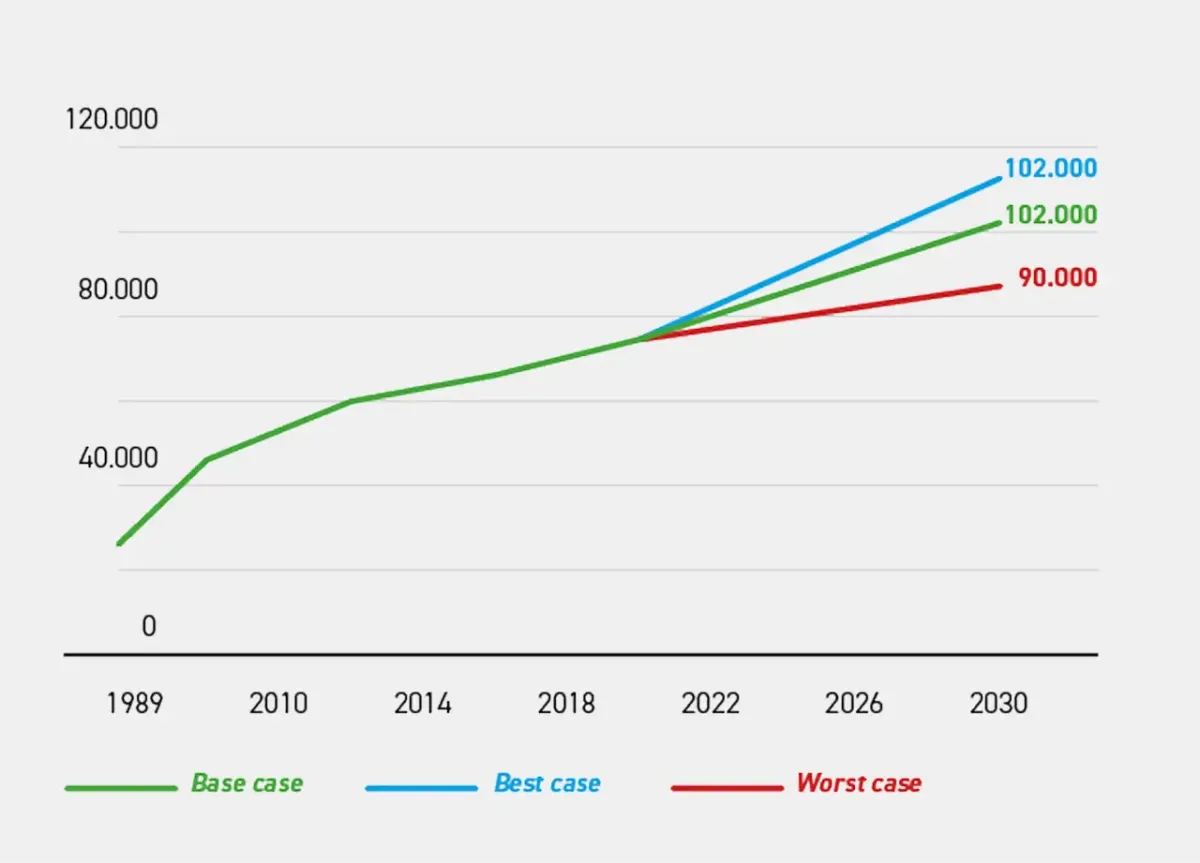
Employment forecast
Silicon Saxony
Number of expected employees in the semiconductor industry in Dresden
Data: Silicon Saxony
Key takeaways from
Silicon Saxony

